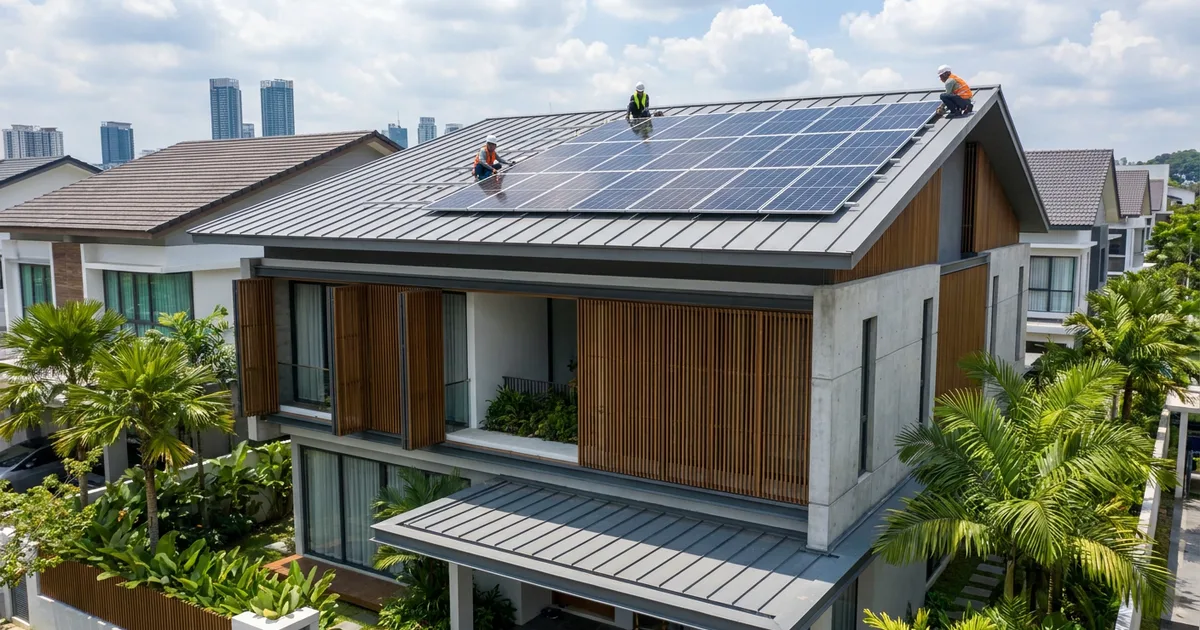
On 22 May 2026, the Malaysian government quietly launched a RM3,000 cash rebate for homeowners who install panel solar, payable directly to your bank account, not as a bill credit. Most homeowners still haven’t heard of it, and the quota is finite.
The rebate is called SuRIA Home, and it carries a national quota of 250 MW, roughly 50,000 households, handed out first-come-first-served. So this is a genuine window, not a marketing line. Before you commit to a system, this guide walks you through everything you need: what panel solar actually is in Malaysia, what size system your home needs, what it costs in 2026, how the new Solar ATAP programme works, and how to compare installers so you don’t overpay. No sales pitch for a specific company, just the full picture and a clear next step.
Apa Itu Panel Solar? (What Is Panel Solar?)
When Malaysians say “panel solar”, they usually mean the whole rooftop system, not just the glass panels on top. A complete sistem solar rumah includes the PV panels, an inverter that converts DC power to the AC your house uses, a mounting structure, the wiring, and the TNB and SEDA metering setup that connects it all to the grid. Buying panels alone does nothing. You are buying a system.
Malaysia is a strong market for this. The country gets 4 to 6 hours of peak sunlight a day, among the best in Southeast Asia, which is why a 5 kWp system here generates far more than the same system would in Germany. Adoption reflects that. As of the end of 2025, Malaysia had 5,777 MW (5.77 GW) of total installed solar capacity, and rooftop solar alone accounts for 1.72 GW, around 40% of the total. Homeowners, not just utilities, are driving this.
One important eligibility point up front. Panel solar under the residential programmes is for landed property owners: bungalows, semi-detached homes, and terrace houses. If you live in a condominium or apartment you are not eligible, because you don’t own the roof. Everything that follows assumes you own your roof.
How Solar Panels Work in Malaysia’s Climate
Sunlight hours are only half the story. How your panels actually perform depends on heat, orientation, shading, and when you use electricity.
Malaysian rooftops can hit 60 to 70°C on a sunny afternoon, and every solar panel loses efficiency as it gets hotter. You cannot stop that, but you can limit it by choosing panels with a low temperature coefficient, which is the single strongest argument for the panel type covered in the next section.
Orientation is the next lever. South-facing roofs capture the most total energy across the year, but a west-facing roof often suits a Malaysian household better, because it pushes peak generation into the late afternoon and early evening when families are home and the air conditioning is running. Output is not flat across the year either. During the monsoon months, heavier cloud cover and rain can pull daily generation noticeably below the dry-season average, so a system sized on a single sunny week will disappoint. A good installer sizes for the yearly average, not the best day.
Shading is the biggest avoidable killer of output. A tree branch or a neighbour’s wall that shades part of the array for even an hour can drag down a whole string of panels, not just the shaded ones. That is why a proper site visit includes a shading assessment across the day, not a glance at a satellite photo. If an installer skips it, the system design is a guess.
The deciding factor for most homes is timing. A typical Malaysian household uses roughly 30% of its electricity during daylight hours, when solar is generating, and 70% at night, when it isn’t. That split is exactly why sizing your system to your own daytime use matters more than chasing maximum generation. Under the current programme, excess power you export is paid at the System Marginal Price (SMP), which is lower than the retail rate you pay to import at night. Using your own solar is worth more than selling it back.
Panel Solar 2026: N-Type TOPCon vs Monocrystalline PERC
There is one technical decision worth getting right, and in 2026 the answer is settled. N-Type TOPCon is now the residential standard in Malaysia. If an installer is still selling you Monocrystalline PERC as the premium option, the quote is out of date.
The gap is real and it shows up in Malaysia’s conditions specifically. TOPCon panels run at 25.5% efficiency or higher, against 23 to 24% for PERC. On the same roof area, that is measurably more output. TOPCon also has a lower temperature coefficient, so it sheds less output on those 60 to 70°C afternoons. That single property matters more here than in cooler markets.
Degradation is where the long game is won. PERC panels lose 1.5 to 2% of output in their first year alone, driven by LID and LeTID effects, then settle to around 0.55% a year. TOPCon loses only about 0.5% in year one and roughly 0.51% a year after that. The annual difference looks tiny, but compounded across a 25-year system life, TOPCon generates meaningfully more electricity from day one to year 25.
TOPCon costs 10 to 20% more than PERC, but for most homeowners that premium is recovered well within the payback period, so it is the right call. The brands showing up most often in Malaysian quotes are LONGi Hi-MO9, Jinko Tiger Neo, and Trina Vertex S+. Module prices are also edging up rather than falling: Tier 1 monocrystalline currently sits around RM1.80 to RM2.50 per watt, and China’s removal of its PV VAT rebate is nudging that trend upward through mid-2026. Waiting a year is unlikely to make the hardware cheaper.
Berapa Saiz Sistem Panel Solar yang Anda Perlukan? (What Size System Does Your Home Need?)
You can size a system from one number you already have: your monthly TNB bill. Not your home’s square footage, not the number of bedrooms. The bill tells you how much electricity you use, and that is what the system has to cover.
Installers use a working table like this one as a starting point.
| Monthly TNB Bill | Estimated kWh/month | Recommended System Size |
|---|---|---|
| RM150–250 | 300–500 kWh | 3 kWp |
| RM250–400 | 500–800 kWh | 4–5 kWp |
| RM400–600 | 800–1,200 kWh | 6–8 kWp |
| RM600–900 | 1,200–1,800 kWh | 8–10 kWp |
| RM900+ | 1,800+ kWh | 10–12 kWp |
Many Malaysian landed homes sit in the RM250 to RM600 a month range, which puts the sweet spot at a 4 to 8 kWp system. For a household with a RM500 bill, a 6 kWp system is the practical optimum: it matches daytime usage without over-generating power you can only export at the lower SMP rate. Bigger is not automatically better. A system that pushes large surpluses to the grid earns you less per unit than one sized to feed your own home.
Treat the table as a guide, not a final answer. A licensed installer still needs a site assessment to factor in roof orientation, shading, and your real peak demand. To get a personalised estimate before you talk to anyone, use our free solar calculator: enter your TNB bill and it returns an instant system size, cost, and payback estimate.
Kos Panel Solar Rumah Malaysia 2026 (Full Cost Breakdown)
A fully installed system, meaning panels, inverter, mounting, installation, and SEDA and TNB registration, should cost RM3,000 to RM4,000 per kWp. Anything above RM4,500 per kWp deserves scrutiny unless you have a difficult flat or concrete roof. Below is the harga panel solar by system size, before and after the new SuRIA Home rebate.
| System Size | Total Cost Range | After SuRIA Home Rebate |
|---|---|---|
| 3 kWp | RM9,000–RM12,000 | RM6,000–RM9,000 |
| 5 kWp | RM15,000–RM20,000 | RM12,000–RM17,000 |
| 6 kWp | RM18,000–RM24,000 | RM15,000–RM21,000 |
| 8 kWp | RM24,000–RM32,000 | RM21,000–RM29,000 |
| 10 kWp | RM30,000–RM40,000 | RM27,000–RM37,000 |
| 12 kWp | RM35,000–RM55,000 | RM32,000–RM52,000 |
For the typical home with a RM500 monthly bill, a 6 kWp system costs RM18,000 to RM24,000 installed. After the RM3,000 SuRIA Home rebate, your net outlay falls to RM15,000 to RM21,000. The payback period for most Malaysian homes runs 3 to 7 years, and a well-matched 6 kWp system usually lands around 4 to 5 years. Over the 25-year life of the panels, a properly sized system saves RM70,000 to RM120,000 in avoided electricity costs.
If the upfront cost is the barrier, bank financing is available at roughly 3.5 to 4.2% per annum, which still leaves most homes cash-flow positive once the monthly saving is set against the loan repayment.
One thing to know before you start collecting quotes: there is no fixed market price for solar. Installers price on volume, overheads, and target margin, so the same 6 kWp system with identical panels and inverter can be priced very differently from one company to the next. That gap is the single strongest reason to get more than one quote, which the installer section below covers in full.
Solar ATAP vs NEM: Apa yang Berubah pada 2026?
If you have read older solar articles, you have seen NEM (Net Energy Metering) mentioned as the route to go solar. That advice is now out of date, and the confusion is worth clearing up.
The old NEM programme ended in June 2025 after awarding more than 2,600 MW of quota. If you were ever stuck on an NEM waiting list, that is why it went nowhere. From 1 January 2026 it was replaced by Solar ATAP (Solar Accelerated Transition Action Programme). The headline change is that Solar ATAP has no fixed quota and no waiting list. You can apply at any time.
The financial mechanics changed too, and this is the part that should shape how you size your system. Under the old NEM, exported energy was credited close to the retail rate. Under Solar ATAP, the energy you export is compensated at the System Marginal Price, which sits below the retail rate you pay to import at night. The practical takeaway repeats the sizing point: build a system that maximises self-consumption rather than one that over-generates to dump power onto the grid.
| Feature | Old NEM (ended Jun 2025) | Solar ATAP (from Jan 2026) |
|---|---|---|
| Quota | Fixed, waiting list | No quota, apply anytime |
| Max system size | 100% of max demand | 100% of max demand |
| Export compensation | NEM tariff (closer to retail) | System Marginal Price (lower) |
| Contract | 10 years | 10 years |
Systems can still be sized up to 100% of your maximum demand, the contract still runs 10 years, and you still apply through SEDA via a registered installer. For the full breakdown of how the two schemes compare, read our full Solar ATAP programme guide.
SuRIA Home Rebate 2026: RM3,000 Cash Back (Tapi Rebat Ini Ada Tarikh Akhir)
This is the section the other articles are missing, and it is the one most likely to change your timing. SuRIA (Sustainable Rebate and Incentive Assistance) Home was launched by PETRA on 22 May 2026. It is a cash rebate of RM600 per kWac installed, capped at RM3,000, which a 5 kWac system and above will hit in full.
The part that matters most is how you are paid. This is cash, paid directly to your TNB-registered bank account. It is not a bill credit or a discount the installer applies. It is real money that lands after your system is commissioned. For a 6 kWp system with a RM3,000 rebate, that is a straight 12 to 15% off your net cost.
The scarcity is built into the programme, not invented for urgency. The national quota is 250 MW, roughly 50,000 households, allocated first-come-first-served. The official deadline is 31 December 2026, but with solar installations accelerating across Malaysia, the quota is the more likely constraint than the calendar date. Once 250 MW is claimed, the programme closes regardless of the date.
Check the eligibility list before you bank on it:
- You are a Malaysian citizen
- The property is landed residential (bungalow, semi-detached, or terrace, not a condo or apartment)
- You hold a low-voltage residential TNB account
- Your Solar ATAP system is commissioned and TNB-approved
- You have not received a prior solar rebate (no previous SolaRIS or NEM rebate)
Claiming it is straightforward. Your installer submits the Solar ATAP application on your behalf, and once the system is commissioned you submit the rebate claim through the MySuRIA portal. The RM3,000 then lands in your bank account. You can read the official terms at suriahome.com.my. One warning: the older SolaRIS rebate quoted a higher headline figure, and some outdated articles still cite it. SolaRIS is closed. SuRIA Home is the live programme, and RM3,000 is the current cap.
Proses Pemasangan Panel Solar: 8 Langkah dari Sebut Harga ke Bayaran Rebat
Knowing the journey end to end removes the fear that keeps homeowners stuck at the research stage. Here is what actually happens, and how long each step takes.
- Site assessment. The installer visits to check roof orientation, shading, your load profile, and your TNB meter type. Red flag: any installer who quotes a price without a site visit.
- Quotation. Get at least three. Prices for the same specification vary more than most people expect, so compare panel brand, inverter brand, warranty terms, and price together, not price alone.
- Sign contract and apply. Your installer submits the Solar ATAP application to SEDA on your behalf, and this is where the SuRIA Home claim is initiated.
- Installation. Usually 1 to 2 days on-site for panels, inverter, and DC and AC wiring. Daily life is barely disrupted.
- TNB inspection and commissioning. TNB schedules a bi-directional meter upgrade. This step can take a few weeks, so plan around it.
- SEDA registration. The system is registered under Solar ATAP and the 10-year agreement is signed.
- SuRIA Home rebate claim. You submit through the MySuRIA portal after commissioning, and the RM3,000 is paid to your TNB-registered bank account.
- Monitoring. Most inverters ship with app-based monitoring such as Sungrow or Huawei iSolarCloud, so you can track daily generation and savings from your phone.
Step two, comparing quotes, is where homeowners struggle most and where the biggest savings hide.
Cara Pilih Kontraktor Panel Solar yang Bertauliah (And Why You Need More Than One Quote)
Start with the non-negotiable. Every installer must be SEDA-registered as an RPVSP (Registered PV Service Provider). Using an unregistered installer is not just risky, it will get your SuRIA Home rebate claim rejected outright. Ask for their SEDA registration number and verify it on the SEDA portal at seda.gov.my. The company must also employ licensed wiremen and chargemen for the grid connection work.
Once you have confirmed registration, compare quotes on more than price:
- Panel brand and model, and check the efficiency spec yourself rather than taking “high efficiency” at face value
- Inverter brand and model, since tier matters (Huawei, Sungrow, and SMA are reliable choices)
- Warranty terms: panels should carry a 25-year performance warranty, inverters 5 to 10 years
- After-sales service: find out who actually handles a warranty claim, a local team or an overseas distributor
- The SEDA registration number, which you ask for and verify
This is also where the price gap from the cost section becomes your leverage. There is no standard market price to anchor to, so quotes for the same specification can differ by a wide margin from one installer to the next, because each prices on volume, overheads, and target margin. We routinely see meaningful gaps between quotes for an identical system, which is the single strongest practical reason to compare more than one. Without a second quote, you have no benchmark to judge whether the first is fair. Doing this yourself takes real time, though: finding installers, scheduling separate site visits, and chasing follow-ups. SolarCompare.my matches you with up to three SEDA-registered installers based on your postcode and system size, so one form gets you three comparable quotes instead of three separate phone trails. We only work with verified SEDA-registered installers on our platform, so the registration check is already done for you.
Where This Leaves You
You now have the full picture. Get N-Type TOPCon, size the system to your TNB bill so you maximise self-consumption under Solar ATAP, expect to pay RM3,000 to RM4,000 per kWp, and claim the RM3,000 SuRIA Home rebate while the 250 MW quota lasts. The two things that decide whether you get a good deal are claiming that rebate before it runs out and comparing at least three installers so you don’t overpay for the same hardware.
The rebate quota is finite and the commissioning process takes weeks, so the clock that matters started on 22 May. The logical next move is to line up your quotes now. Compare solar quotes from SEDA-registered installers and you will have real numbers for your own roof in a couple of minutes.