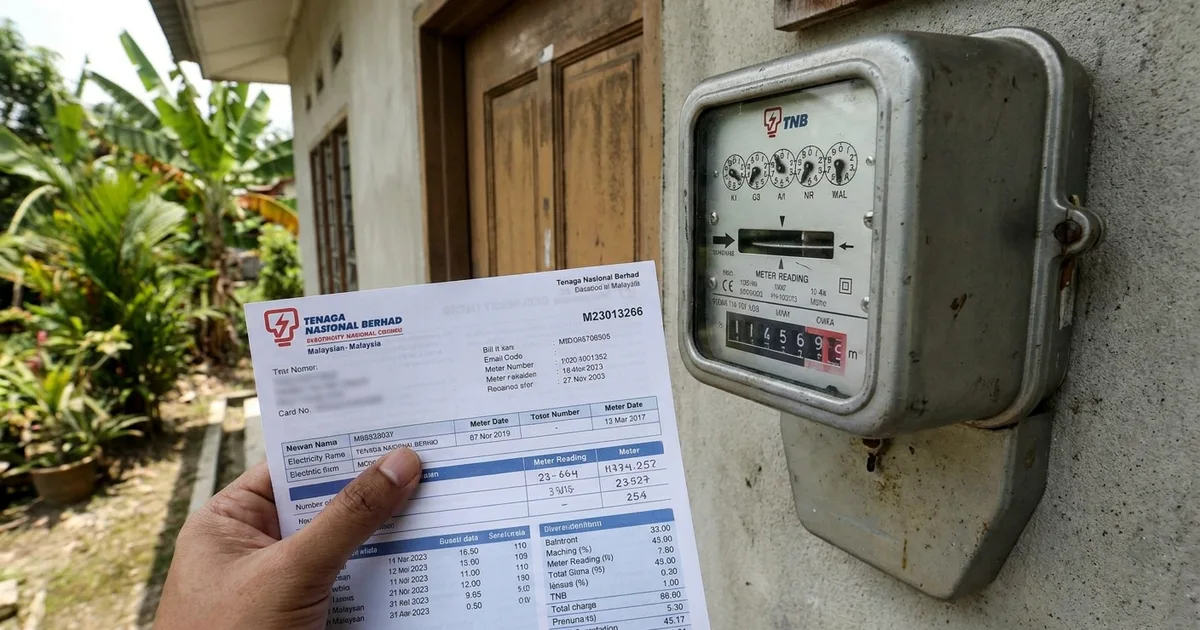
Your January TNB bill may have been slightly cheaper than expected. Your June bill almost certainly won’t be, and the reason is a mechanism most Malaysians have never heard of.
In January 2026, TNB was handing customers a rebate of 4.99 sen for every kWh they used. By June 2026 that had flipped to a 2.59 sen surcharge. That is a swing of 7.58 sen/kWh in six months, and almost nobody reported it. Sitting underneath that is a permanent base tariff increase of 13.64% that landed in July 2025 and is never coming back down.
So your confusion is justified. The bill format genuinely is complex, the rules changed twice in a year, and nobody has put the whole picture in one place. This guide does. We will walk through how to check your bill, decode every line on it, explain exactly why the total keeps climbing, and rank the five things that actually bring it down. SolarCompare.my is not an installer and we have no system to sell you, so we can tell you what works without grinding an axe.
How to Check Your TNB Bill
There are three ways to pull up your bill, and all of them are free. The fastest is the myTNB web portal. Go to mytnb.com.my, log in with your MyKad IC number or your registered email, then open Information, followed by Bill & Payments. Your current bill and full payment history sit there, and you can download any month as a PDF.
The myTNB mobile app, on iOS and Android, shows your current bill on the main dashboard the moment you open it. Older statements live under the Bills section. If you would rather speak to a person, the TNB Careline on 1-300-88-5454 is open weekdays 8am to 7pm and weekends 8am to 5pm.
You will need your account number for any of these. It is a 12-digit figure printed at the top-left of a physical bill, or in the app under My Account, then Electricity Supply Account List. One thing worth knowing: many homes now have smart meters (AMI), which TNB reads remotely. That has made estimated readings far less common than they used to be, so the number on your bill is increasingly the real one.
Pulling the bill up is the easy part. Reading it is where most people stall, so here is every line decoded.
How to Read Your TNB Bill: Every Line Explained
Most TNB bills pack seven or eight charges into a layout that explains none of them. Here is what each line actually means, and why it matters for the total you pay.
Account number and billing period. The 12-digit account number and the start and end dates confirm you are reading the right account for the right month. Check these first, especially if you manage more than one property.
Meter reading type: Sebenar or Anggaran. “Sebenar” means an actual read; “Anggaran” means an estimate. Smart meters have removed the estimate for most households, but if you still see “Anggaran”, your usage was guessed rather than measured, and it will true up later.
Consumption (kWh). This is your current meter reading minus the previous one. It is the raw number every charge below is calculated from, so it is the figure to watch month to month. (To rebuild your whole bill from this number line by line, use our TNB bill calculator.)
Base tariff charges. Since July 2025 the residential standard tariff runs at a single base rate of 45.4 sen/kWh, up from 39.95 sen/kWh before. The old Tier 1, Tier 2, Tier 3 block breakdown no longer appears on standard residential bills. One rate now applies across your usage.
AFA (Pelarasan Bahan Api Automatik). This is the automatic fuel adjustment, a monthly surcharge or rebate that passes global fuel cost changes straight through to you. It shows as its own line, and it is the line that moves the most. Households using 600 kWh a month or less have this component waived entirely, so it reads as zero for them.
KWTBB (Kumpulan Wang Tenaga Boleh Baharu). The Renewable Energy Fund surcharge, charged at 1.6% of your consumption charges. It is small, and it funds Malaysia’s feed-in tariff programme that pays for renewable generation. You cannot opt out of it.
Service tax. Applied to the taxable components of your bill. Some charges are exempt and are labelled “Tidak Kena ST”, so the tax is not levied on the whole total.
You can now read every line of your bill. But the more important question is why the total keeps going in one direction only.
Why Your TNB Bill Is Rising in 2026
If you have been searching why your TNB bill is so high in 2026, the answer is three forces stacking on top of each other. This is not a billing error.
Force one: a permanent base tariff increase. On 1 July 2025 the base rate rose 13.64%, from 39.95 to 45.4 sen/kWh. This is the new TNB tariff under the RP4 regulatory framework, and it is funded by a RM42.9 billion capital expenditure commitment to modernise the grid between 2025 and 2027. It is baked in indefinitely. This is the floor your bill now sits on, and it does not move down.
Force two: the AFA swinging from rebate to surcharge. The electricity tariff in Malaysia now adjusts every month through the AFA. Fuel prices were low at the start of the year, so TNB gave money back. As fuel costs climbed, the rebate shrank and then reversed. Here is the full trajectory for 2026 so far, with each month’s rate as announced by the Energy Commission.
| Month | AFA Rate | Effect on Bill |
|---|---|---|
| January 2026 | -4.99 sen/kWh | Rebate |
| February 2026 | -2.77 sen/kWh | Rebate |
| March 2026 | -2.15 sen/kWh | Rebate |
| April 2026 | -0.47 sen/kWh | Near-neutral |
| May 2026 | +1.38 sen/kWh | Surcharge |
| June 2026 | +2.59 sen/kWh | Surcharge |
The AFA is capped at 3 sen/kWh in either direction per month, and anything larger needs Cabinet approval. The direction of travel is what matters here. In six months it has gone from a generous rebate to a surcharge closing in on the cap. You can track each month’s figure as TNB and the Energy Commission announce it; paultan.org publishes the rate at the start of every month.
Force three: the 600 kWh exemption line. Households using 600 kWh a month or less pay no AFA at all. Above that threshold, both the permanent base tariff increase and the AFA surcharge hit your bill together. TNB stated that 23 million consumers would be unaffected by the 2025 restructure, but that referred to protecting affordability for sub-600 kWh homes, not freezing everyone’s bill. If you use more than 600 kWh per month, the 13.64% base increase is permanent and the AFA has already swung from a 4.99 sen rebate to a 2.59 sen surcharge in six months. Both forces are stacked on your bill now, and neither is temporary.
Knowing why the bill rose does not knock a single sen off it. These five moves do, ranked by how much they actually shift the total.
5 Ways to Cut Your TNB Bill (Ranked by Impact)
These are ranked by how much they move your bill, not by how easy they are. They are not equally good, and pretending otherwise would waste your time.
1. Go solar (highest impact, capital required). A properly sized rooftop system cuts a monthly TNB bill by 60 to 90%. There are two main pathways: NEM Rakyat 3.0, where surplus you export is offset against your bill at a one-to-one rate, and Solar ATAP, where TNB buys your output at a feed-in tariff. A third option, TNB Solar direct, asks for zero upfront and adds a monthly payment to your bill while TNB maintains the system. Green financing through the major Malaysian banks starts at roughly 3.5%. Solar is not right for every home. The target is an owner-occupied house with a south or west-facing roof and a bill above RM200 a month. A flat or heavily shaded roof is a harder case. For a full breakdown before you decide which scheme to apply for, read our full breakdown of NEM vs Solar ATAP.
2. Switch to the Time-of-Use (ToU) tariff (free, no hardware). Domestic users have been able to opt into ToU since July 2025, and for the right household it is the highest-value change that costs nothing. Instead of one flat energy rate of 27.03 sen/kWh, you pay 28.52 sen/kWh during peak hours, which run 2pm to 10pm on weekdays, and 24.43 sen/kWh off-peak, which covers 10pm to 2pm on weekdays plus all day on weekends and public holidays. The maths only works if you can genuinely shift load: run the dishwasher, the laundry, and any EV charging inside the off-peak window. A household that already burns most of its power during the evening peak can end up paying more, so check your own usage pattern against those rates before you switch. If the account is in your name, the switch itself is free and needs no equipment.
3. Claim the Energy Efficiency Incentive (EEI). Households on the standard tariff that cut their consumption against the same period last year can earn a rebate. It rewards a genuine year-on-year reduction rather than any billing trick, which is why it stacks naturally with the appliance and habit changes below: the more you actually save, the larger the incentive. The exact thresholds and rebate bands are set by TNB and shift over time, so check the current figures on the myTNB portal before you count on a number.
4. Upgrade your appliances. Air conditioning is the single largest load in most Malaysian homes, so that is where hardware spending pays back. Swapping old units for 5-star energy-rated inverter air conditioners, and replacing ageing fridges and water heaters, reduces your draw meaningfully. Treat this as a multi-year payback on a purchase, not an instant fix.
5. Consumption habits (lowest impact, zero cost). Set your air conditioning to 25°C or higher, since every degree colder raises energy use by around 6%. Use LED lighting and unplug standby appliances. Be honest with yourself about the scale here: these trim your bill at the margins, not by 30 to 40%.
Renting? Options 2, 3, and 5 are open to you regardless of who owns the property. Solar needs the landlord’s consent and money, and most landlords say no. Ask yours about the ToU tariff first. It is a free tariff switch with no hardware, and if the account is in your name you can make it yourself.
Solar is consistently the highest-impact option. But what does a lower TNB bill actually look like for a Malaysian household that goes solar?
What Solar Actually Does to Your TNB Bill
Here is a real example rather than a sales projection. A household running an 11-panel system that generates around 500 kWh a month saves roughly RM330 or more off its monthly TNB bill. That is the bill going from a figure that hurts to one that barely registers.
At an installed cost of RM5,000 to RM6,500 per kW, a typical 5kW system runs RM25,000 to RM32,500 before any incentives. At current tariffs the payback period lands at 4 to 6 years, after which the system keeps generating for two more decades at no cost. To size a system for your own roof, SEDA’s solar PV calculator at seda.gov.my is the authoritative tool.
Now the counterintuitive part. Rising tariffs do not weaken solar’s case, they strengthen it. Every time TNB lifts the base rate or the AFA climbs toward its cap, the electricity your panels offset becomes worth more, which shortens your payback. The person who delays going solar by 12 months pays the higher bill for all 12 of those months, and risks the incentive landscape shifting against them in the meantime. The window on a clean 4 to 6 year payback is open now precisely because tariffs are rising, not despite it.
One distinction to keep clear: NEM Rakyat offsets your exported energy against your bill at a one-to-one rate, while Solar ATAP sells your output to TNB at a feed-in tariff set by the scheme. Which one suits you depends on how much of your generation you use at home versus export, and that is exactly the kind of thing a registered installer should size for. TNB publishes the current ATAP feed-in rate on its Solar Energy Purchase page, so you can check the live number before you apply. The hard part is finding good installers and getting comparable quotes. Compare quotes from SEDA-registered installers in your state through our free tool and you skip the phone trail entirely.
The bill is not going to start falling on its own. The base tariff increase is permanent and the AFA is trending toward its ceiling, so for any household above 600 kWh a month, doing nothing means paying more every month indefinitely. The first step toward lowering it is understanding exactly what you are being charged for, and now you do. The second step, if your roof and your bill suit it, is to get three quotes from SEDA-registered installers and see the real numbers for your own home.